The AI Code Review Tool That Catches Real Bugs

Macroscope is an AI code reviewer that reads your whole codebase and reviews every pull request, catching real bugs with 4X less noise than other tools.

Automated code review runs the moment a PR opens, so PR review never waits on a senior engineer. Connected directly to your GitHub, Slack, Linear, and Jira.

Usage-based pricing: around $0.95 per review, never per seat. $100 in usage credit to start. Setup under 5 minutes. SOC 2 Type II.
Deep Code Review

Real bugs, not nitpicks. The highest signal-to-noise code review.

Code Review
Macroscope Code Review works in every language
Python logoPython
TypeScript logoTypeScript
Kotlin logoKotlin
Java logoJava
Rust logoRust
Swift logoSwift
Go logoGo
Python logoPython
TypeScript logoTypeScript
Kotlin logoKotlin
Java logoJava
Rust logoRust
Swift logoSwift
Go logoGo
Higher Signal Reviews graphic

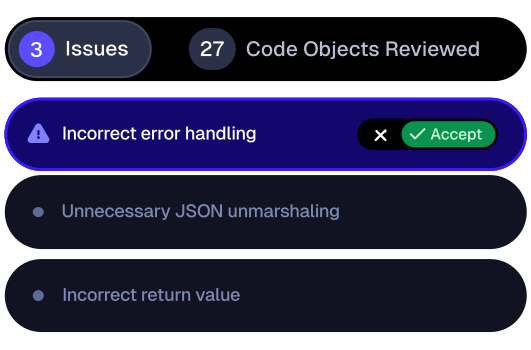
High Signal, Low Noise

Macroscope won't spam you with noisy false positives. Using the latest AI reasoning models, Macroscope identifies correctness issues you'll want to fix. It's the only code review tool you won't want to turn off.

Deeply Understands your Codebase graphic

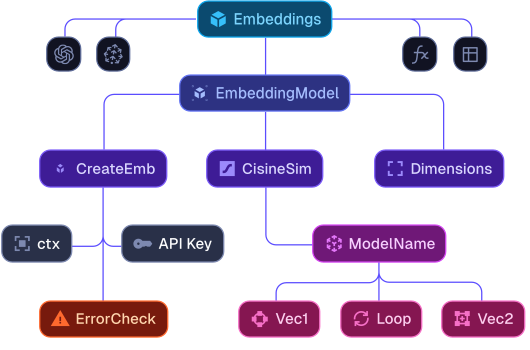
Deep Codebase Understanding

Macroscope uses Abstract Syntax Trees (AST) to create a graph-based representation of how your codebase works, allowing it to find hard-to-detect bugs while avoiding false-positives.

Absorbs context from your tickets graphic

Context from your tickets

Macroscope pulls context from your issue management systems to understand the 'why' behind each change. It evaluates your PRs against their linked tickets and reviews them for issues using that context.

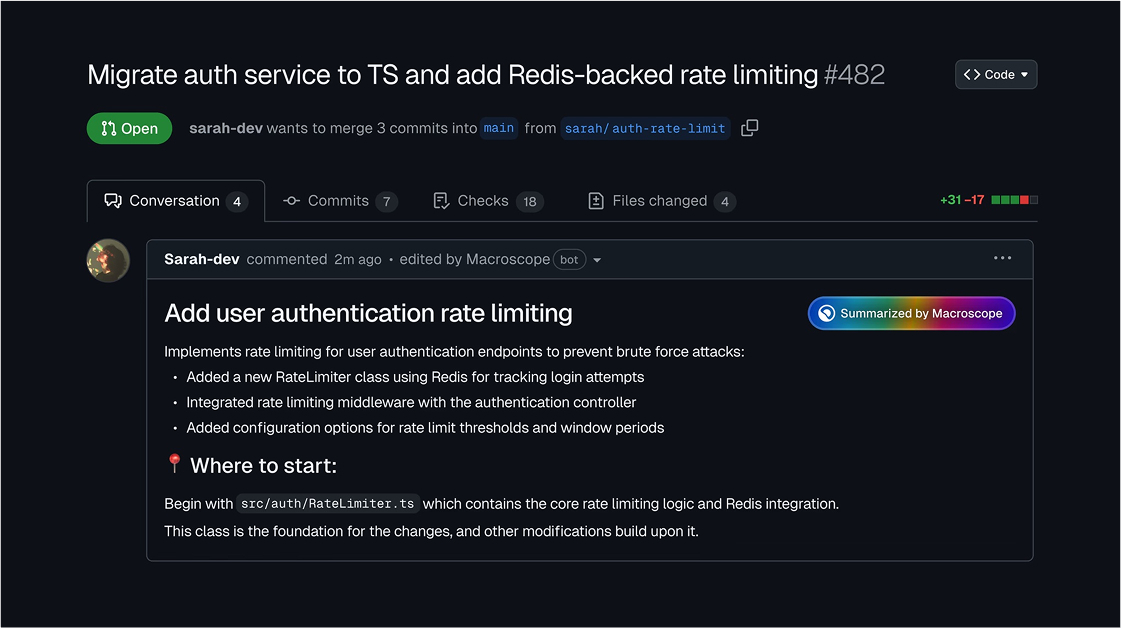
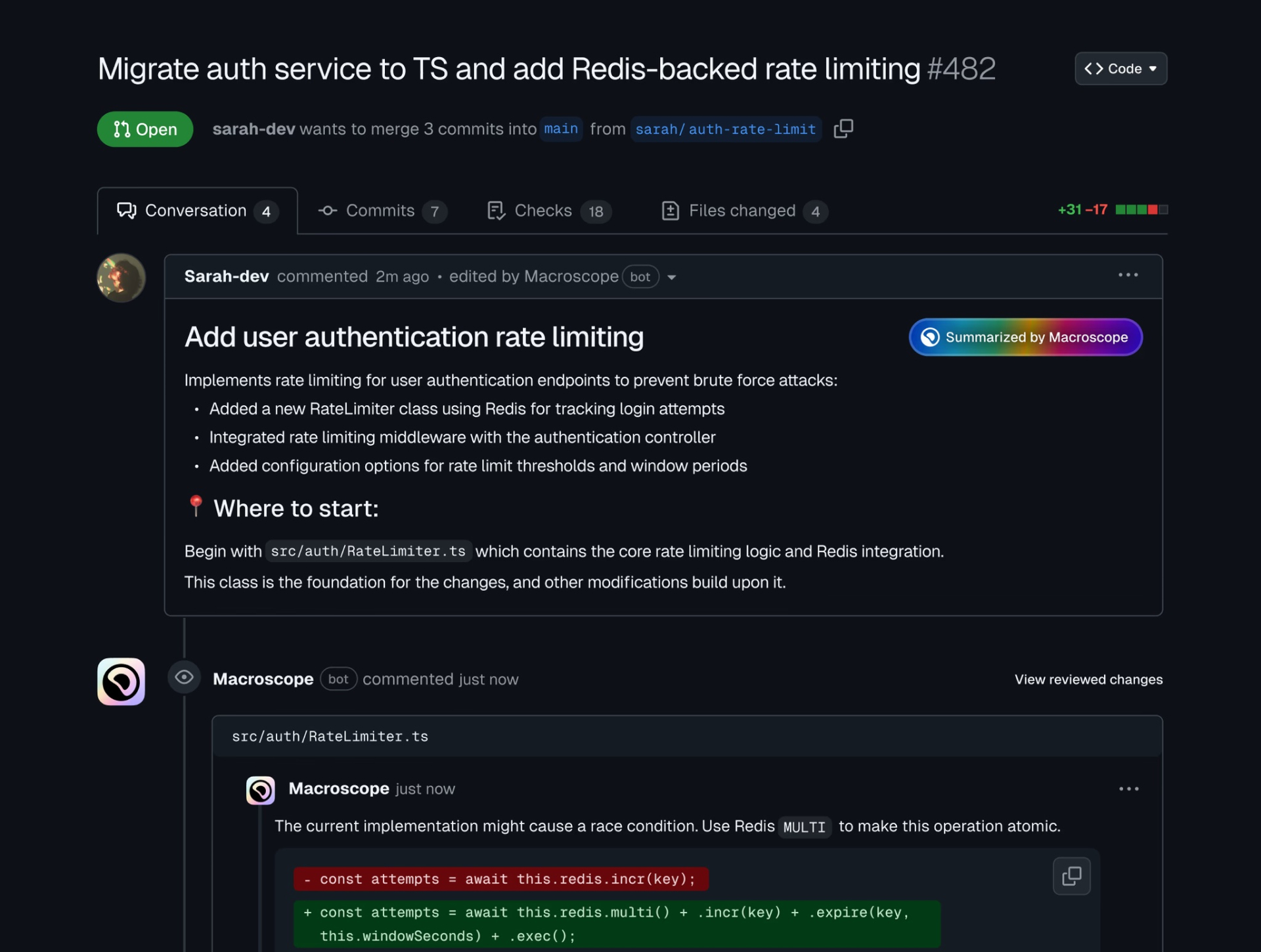
Automated PR Summaries

Concise, AI-generated summaries surface key changes instantly so that engineers spend less time managing pull requests.

PR description screenshot

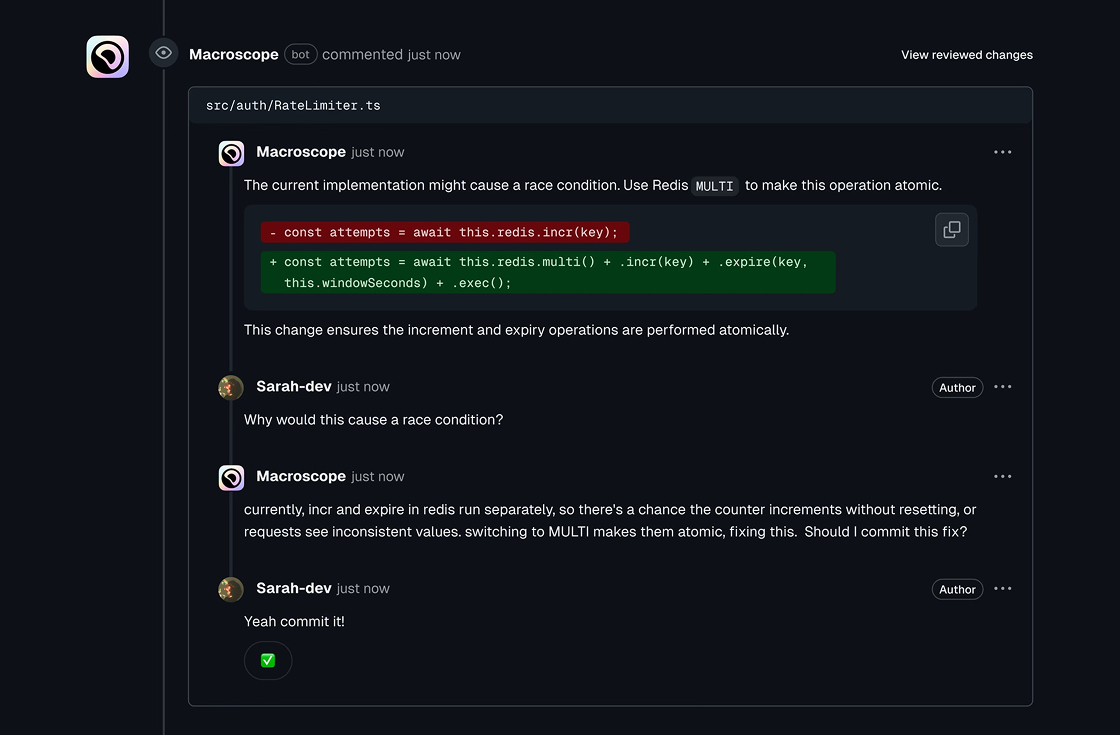
Bug Detection & Fixes

Macroscope automatically catches issues in your Pull Requests, and suggests fixes.

Code comment screenshot

Benchmark Results

Macroscope achieved the highest detection rate of bugs from our dataset of production bugs from open source repos.

Learn more about our methodology

Frequently Asked Questions

Macroscope builds a graph-based representation of your entire codebase. This approach allows Macroscope to detect subtle bugs that other AI reviewers often miss.

No. Macroscope integrates directly into your existing workflow and is designed to complement your existing tools. Once installed, Macroscope will automatically start summarizing PRs and leaving code review comments directly on GitHub.

Yes. Product managers, engineering managers, customer success teams, and executives use Macroscope to stay informed about what's changing in their product and codebase.

All of them. Macroscope reviews pull requests in every language, so there is no list to check your stack against. Commit and PR summaries, project tracking, and productivity insights work across every language too.

Macroscope is used by startups and enterprise engineering teams alike, from 5-person teams to 100+ engineer orgs.

Teams can get up and running in under 5 minutes. Install the GitHub app, connect Slack (optional), and you're ready! New customers get $100 in usage credit so you can get going right away. It's usage-based, so you only pay for the code you review. Macroscope immediately begins analyzing open PRs and backfilling recent code activity.

Yes. Macroscope installs as a GitHub app and reviews every pull request automatically, posting comments inline the moment a PR opens. Unlike a rules-based bot, it builds a graph of your entire codebase first, so it comments on bugs that matter instead of pattern-matching on style.

Macroscope is usage-based and averages around $0.95 per review. You pay per pull request reviewed, not per developer seat, so your cost tracks how much code you actually ship rather than how many people are on the team. New teams start with $100 in usage credit.

Linters and static analysis match patterns inside a single file. Macroscope builds a graph-based representation of your whole codebase using Abstract Syntax Trees, so it catches bugs that span files, functions and services, which is the class of bug a linter structurally cannot see. It also means far fewer false positives, because it can tell whether a suspicious line is actually reachable.

Yes, and it is the main reason teams adopt it. When Copilot, Cursor or a coding agent writes most of a pull request, the bottleneck moves from writing code to reviewing it. Macroscope reviews AI-written PRs the same way it reviews human ones, and around 40% of pull requests end up auto-approved so engineers only look at what genuinely needs a human.

It depends what you want it to catch. On our benchmark of real production bugs from open source repositories, Macroscope had the highest detection rate of the tools tested, with 4X less noise than the next closest. Run the comparison yourself: most teams evaluate on a week of their own pull requests, which is a better signal than any vendor benchmark including ours.

Both, depending on how you use it. As an AI code review platform it reviews every pull request, writes PR summaries, and gives engineering leaders a view of what is shipping. Most teams start with automated PR review on GitHub and adopt the rest later.

Traditional code quality tools score a snapshot of your repository against fixed rules, which is useful for tracking coverage and style but rarely catches a real bug. AI-powered code review reasons about the change itself, in the context of the codebase around it, and tells you what will break. Teams generally keep both: one for hygiene, one for correctness.

Not yet. Macroscope currently supports GitHub, and GitLab and Bitbucket are on the roadmap. If you are on either one, book a demo and we will let you know when support lands.

Ready to Get Started?

Join teams building with Macroscope to catch more bugs and merge PRs faster than ever. Simple usage-based pricing. No seat fees, no surprises.