Macroscope catches more bugs than CodeRabbit, with 4X less noise

The #1 CodeRabbit alternative. Macroscope reviews every pull request, catches real bugs and suggests the fix. 40% of PRs are auto-approved across all customers, so your team only reviews what actually needs attention.

Real bugs, not nitpicks. Macroscope flags correctness issues worth fixing instead of style noise, and installs on GitHub in under five minutes.

Macroscope is usage-based: you pay per review, not per seat. CodeRabbit Pro starts at $24 per user, per month. Start with $100 in usage credit.

People seem to like it...

Nick Molnar
Nick Molnar
CTO Ephemera (building XMTP)
We've used just about every AI-driven PR assistant out there: the signal to noise from Macroscope is the best I've seen. The PR descriptions are better than what we would have written by hand, and when it flags an issue it's almost always a real bug.
Marcel Molina
Marcel Molina
CTO & Cofounder, Particle
Macroscope is like having a distinguished engineer tech lead who's read every diff, understands every project, and can answer any question about your codebase instantly. We can finally focus on shipping instead of process.
Jason Toff
Jason Toff
CEO, Things Inc / Rooms.xyz
Within 24 hours of installing Macroscope, engineers on my team said things like, 'wow, that is scary accurate for a very complex thing,' and, 'much better than my own linear summary or Git commit.'

How Macroscope Compares to CodeRabbit

Macroscope catches more real-world bugs*, delivers less noisy reviews*, and supercharges your entire development workflow: broadcasting code activity, answering codebase questions, and giving leaders visibility.

MacroscopeCodeRabbit
Pricing
Usage-based pricing$24 / user / month ("Pro" plan), usage-based add-on on top
AI-Powered Bug Detection
Industry-leading bug detection. In a benchmark evaluation of real-world bugs, Macroscope caught 5% more bugs than CodeRabbit.*
Good, but ranked below Macroscope in runtime bug detection.*
Noise in Code Review
Top signal-to-noise ratio.
Most noisy, generating over 4X more comment volume than Macroscope.*
Productivity Insights
Built-in productivity analytics. Dashboards and reports give leaders visibility into trends, classified by projects.
Lacks productivity analytics; no project classification.
Reports & Macros
Customizable recurring prompts.
Basic custom reports limited to PR metrics.
Integration with Jira and Linear
Context from tickets. Macroscope uses context from your issue trackers to better understand your team's code.
Doesn't use context from tickets in code review.
Broadcast Code Activity in Slack
Live code updates. Stream commit and PR summaries in real time so your team stays informed without leaving Slack.
No live, real-time stream of activity in Slack.
Query Directly in Slack
Ask your code anything. Ask Macroscope about your codebase and git log, directly in Slack.
No code querying capabilities in Slack.
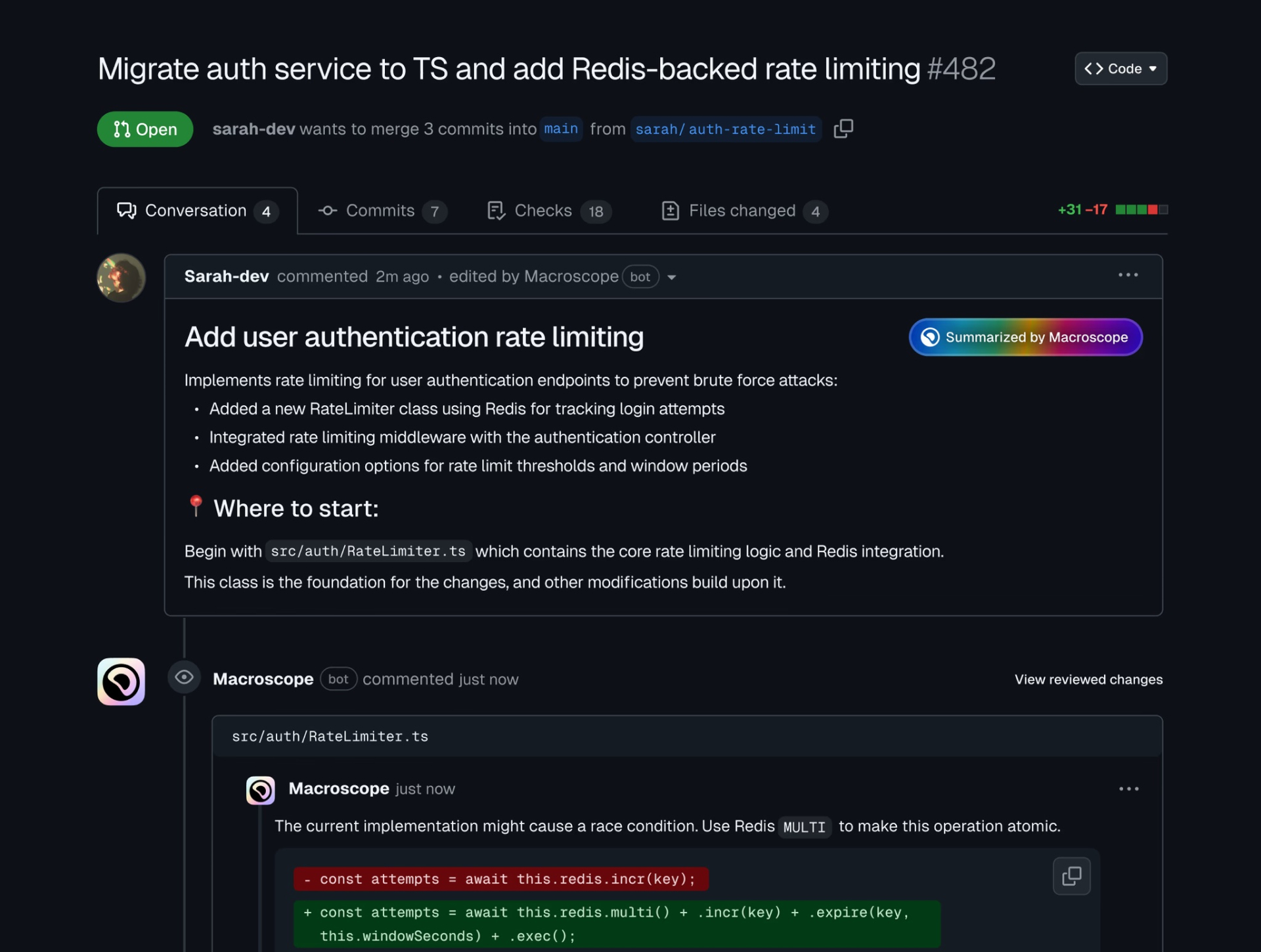
PR Summaries in GitHub
Automated PR Summaries

The Understanding Engine for Your Codebase

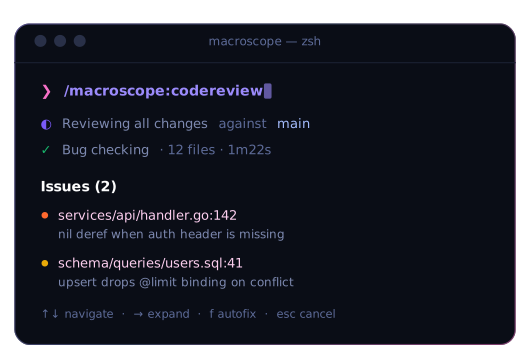
Code Review
Macroscope Code Review works in every language
Python logoPython
TypeScript logoTypeScript
Kotlin logoKotlin
Java logoJava
Rust logoRust
Swift logoSwift
Go logoGo
Python logoPython
TypeScript logoTypeScript
Kotlin logoKotlin
Java logoJava
Rust logoRust
Swift logoSwift
Go logoGo
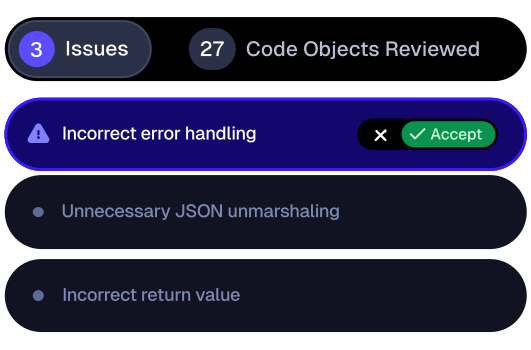
Higher Signal Reviews graphic

High Signal, Low Noise

Macroscope won't spam you with noisy false positives. Using the latest AI reasoning models, Macroscope identifies correctness issues you'll want to fix. It's the only code review tool you won't want to turn off.

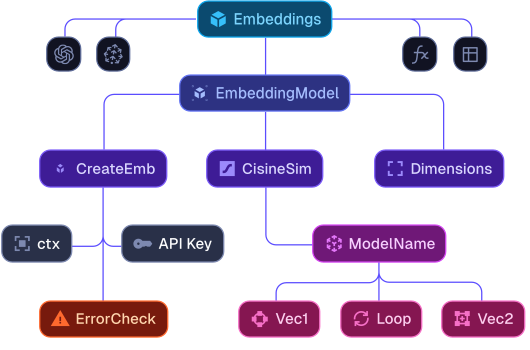
Deeply Understands your Codebase graphic

Deep Codebase Understanding

Macroscope uses Abstract Syntax Trees (AST) to create a graph-based representation of how your codebase works, allowing it to find hard-to-detect bugs while avoiding false-positives.

Absorbs context from your tickets graphic

Context from Your Tickets

Macroscope pulls context from your issue management systems to understand the 'why' behind each change. It evaluates your PRs against their linked tickets and reviews them for issues using that context.

Security

Keeping your data secure is of paramount importance to us. We have rigorous technical, operational and contractual safeguards in place to protect customer data.

SOC II Compliance
SOC 2 Type II Compliant

Visit our Trust Center to request copies of our audited documentation.

Data encryption
Data Encryption

All customer data is encrypted at rest and in transit.

Code isolation and security
Code Isolation

Customer Code is architecturally isolated and secured by design. None of our employees can access your source code.

No training policy
No Training on Source Code

Macroscope does not train models using your source code, and our agreements with model providers ensure they do not train using your IP.

Frequently Asked Questions

Macroscope builds a graph-based representation of your entire codebase. This approach allows Macroscope to detect subtle bugs that other AI reviewers often miss.

No. Macroscope integrates directly into your existing workflow and is designed to complement your existing tools. Once installed, Macroscope will automatically start summarizing PRs and leaving code review comments directly on GitHub.

Yes. Product managers, engineering managers, customer success teams, and executives use Macroscope to stay informed about what's changing in their product and codebase.

All of them. Macroscope reviews pull requests in every language, so there is no list to check your stack against. Commit and PR summaries, project tracking, and productivity insights work across every language too.

Macroscope is used by startups and enterprise engineering teams alike, from 5-person teams to 100+ engineer orgs.

Teams can get up and running in under 5 minutes. Install the GitHub app, connect Slack (optional), and you're ready! New customers get $100 in usage credit so you can get going right away. It's usage-based, so you only pay for the code you review. Macroscope immediately begins analyzing open PRs and backfilling recent code activity.

Yes. Macroscope installs as a GitHub app and reviews every pull request automatically, posting comments inline the moment a PR opens. Unlike a rules-based bot, it builds a graph of your entire codebase first, so it comments on bugs that matter instead of pattern-matching on style.

Macroscope is usage-based and averages around $0.95 per review. You pay per pull request reviewed, not per developer seat, so your cost tracks how much code you actually ship rather than how many people are on the team. New teams start with $100 in usage credit.

Linters and static analysis match patterns inside a single file. Macroscope builds a graph-based representation of your whole codebase using Abstract Syntax Trees, so it catches bugs that span files, functions and services, which is the class of bug a linter structurally cannot see. It also means far fewer false positives, because it can tell whether a suspicious line is actually reachable.

Yes, and it is the main reason teams adopt it. When Copilot, Cursor or a coding agent writes most of a pull request, the bottleneck moves from writing code to reviewing it. Macroscope reviews AI-written PRs the same way it reviews human ones, and around 40% of pull requests end up auto-approved so engineers only look at what genuinely needs a human.

It depends what you want it to catch. On our benchmark of real production bugs from open source repositories, Macroscope had the highest detection rate of the tools tested, with 4X less noise than the next closest. Run the comparison yourself: most teams evaluate on a week of their own pull requests, which is a better signal than any vendor benchmark including ours.

Both, depending on how you use it. As an AI code review platform it reviews every pull request, writes PR summaries, and gives engineering leaders a view of what is shipping. Most teams start with automated PR review on GitHub and adopt the rest later.

Traditional code quality tools score a snapshot of your repository against fixed rules, which is useful for tracking coverage and style but rarely catches a real bug. AI-powered code review reasons about the change itself, in the context of the codebase around it, and tells you what will break. Teams generally keep both: one for hygiene, one for correctness.

Not yet. Macroscope currently supports GitHub, and GitLab and Bitbucket are on the roadmap. If you are on either one, book a demo and we will let you know when support lands.

Ready to Get Started?

Join teams building with Macroscope to catch more bugs and merge PRs faster than ever. Simple usage-based pricing. No seat fees, no surprises.